
Friday, 14 October 2011
Sprint to offer three levels of iPhone service, 'yellow' AppleCare+ repairs will cost $49

Samsung confirms Ice Cream Sandwich event on October 19

Ubuntu 11.10 'Oneiric Ocelot' now available to download

Google announces Q3 earnings: $9.72 billion in revenue, $2.73 billion net income, 40 million Google+ users

Google's just announced its third quarter earnings and, as expected, the company's numbers are continuing on the upswing (even beating expectations). That includes $9.72 billion in revenue, which represents a 33 percent jump compared to the third quarter of 2010, along with $2.73 billion in net income, which is up from $2.17 billion a year ago. Somewhat notably, Google also choose to lead off its press release announcing the financial results (included after the break) with the news that Google+ has just passed the 40 million user mark -- the company further notes that "people are flocking into Google+ at an incredible rate." There's not a ton of surprises to be found in the results otherwise, although Larry Page and co. sure seem to be busy hiring new folks -- they've brought on 10 percent more employees in the span of three months (for a total of 31,353 full-time employees as of September 30th).
Update: During the company's earnings call, CEO Larry Page confirmed that there's now 190 million Android phones activated around the world, and 200 million users of the Chrome web browser (although it's not clear how many of those are active users). Page also took a moment to post his remarks to Google+ during the call.
Jawbone's Up wristband warms up at AT&T store, wants you faster, stronger

Chinese researchers create ping-pong playing robots, trash talk still needs work

Sprint explains iPhone 4S unlocking policy: phones will be unlocked, then locked, then unlocked again

"Sprint's policy is to have the iPhone 4S SIM locked to our network domestically and internationally. At launch, the International SIM will be unlocked. We do expect a SIM lock to be pushed to the devices shortly after launch. We will then allow existing customers in good standing to unlock the SIM for international use if needed in the future."So, if we're reading that correctly, the iPhone you purchase and activate will be unlocked. Then, a SIM lock will be "pushed" to your device. But, if you've been a good, policy-abiding customer, your iPhone can then be unlocked manually by Sprint. Who knows what'll happen if you buy your phone and flee to a non-extradition country before Sprint comes knocking at the door, shackles in hand. Will you be left to live in peace with your newly-acquired international Micro SIM? Will you need to plead your case before a tribunal of mobile carrier overlords? Only time will tell, we suppose, or perhaps further clarification from Sprint. Jump past the break for the complete announcement.
Hulu owners 'terminate sale process', won't sell to anyone

Google Translate for Android gets v2.2 update, adds more language support for speech-to-speech

Thursday, 13 October 2011
DNAnexus Raises $15 Million, Teams With Google To Host Massive DNA Database

It was only a few years ago that 23andMe and other personal genomics companies began to fulfill the futurisitic promise of allowing consumers to test their own DNA for hundreds (rather than hundreds of thousands) of dollars. And now it won’t be long until these screens become far more exhaustive, with such tests comprising your entire genome, rather than just specific portions of it.
Society still has plenty of thinking to do when it comes to the privacy and ethical issues involved — but from a straight logistical perspective there’s another thing we need to consider: every person’s DNA sequence represents a huge chunk of data spanning hundreds of gigabytes.
Today a company called DNAnexus is announcing that it’s raised $15 million from Google Ventures and TPG Biotech to help help scientists and genome-related services host and manage this data. Also participating in the round are First Round Capital, SoftTech VC, K9 Ventures, and Felicis Ventures. As pat of the deal, Google Ventures partner Krishna Yeshwant will be joining the company’s board, as will TPG Biotech partner and managing director Geoff Duyk.
In addition to the funding, the company is also announcing a key partnership: it’s's teamed with Google to give a long-term home to the Short/Sequence Read Archive (SRA) database. This immense dataset, which spans 400 terabytes at this point, includes publically available whole-genome sequences that scientists can use for research purposes. The data has previously been housed by the government at the NCBI, but federal cuts mean that organization can no longer shoulder the burden, which is where DNA Nexus and Google are stepping in.
I spoke with CEO Andreas Sundquist for some time about the longer-term vision of DNAnexus. Sundquist says that DNAnexus wants to provide the underlying infrastructure for managing our DNA in the future. At this point it’s still unclear what that will entail — we don’t know, for example, whether our doctors are going to be managing our DNA profiles, or whether consumers will be responsible for them. But either way, DNAnexus wants to help power these databases and services.
Of course, when you’re looking to host the world’s DNA profiles, privacy is a major concern. Sundquist says that the the company has a heavy focus on maintaining both security and privacy, with an approach that uses Google’s underlying technology as a base and expands beyond it. I’m guessing that if this does take off, we’ll see further government-mandated security measures and audits.
AwayFind Raises $800,000 In Seed Funding, Now Available For Google Apps

Email productivity tool AwayFind announced today that it has closed its seed round of $800,000, led by 500 Startups and CAP Ventures, with participation from several angels, including Ben Lilienthal, Anton Sutton and Amir Banifatemi.
The company is also launching its new product for business, available now in the Google Apps Marketplace. This new service includes an integrated Gmail gadget, new subscription plans starting at $10 per month and instant alerts.
In case you’re unfamiliar with AwayFind, the company serves the oddly overlooked, but insanely practical need to address the “email overload” situation. Instead of constantly checking your inbox for important messages, AwayFind lets you configure when and how to alert you of urgent emails, using notifications that are sent out through SMS, phone calls (yes, old school calls!) or smartphone apps running on the iPhone or Android devices.
Obviously, the target market for AwayFind’s revenue monetization options is the business customer, which is why today’s Google Apps offering makes sense. This more professional-grade service includes an administration control panel that enables I.T. to provision AwayFind for Google Apps users, check on account issues and manage the system. And as before, AwayFind uses oAuth for Google Apps email checking, and is fully PCI compliant.
Maide Turns Your iPad Into A 3D Controller
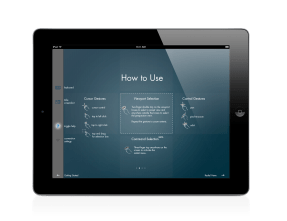
It’s a simple notion: the app connects your iPad (wirelessly) to a big monitor used for 3D design, and then you use multi-touch gestures to zoom, pan, and rotate around that design, and to sketch, add, edit, and erase. It’s pretty easy to use, too — even I, who failed first-year drafting as an engineering student, found it slick and semi-intuitive. You can hook up multiple iPads to the same design to collaborate, and I expect they’ll eventually let users add and customize a personal palette of input/editing options.
Subscribe to:
Posts (Atom)